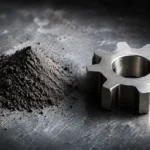

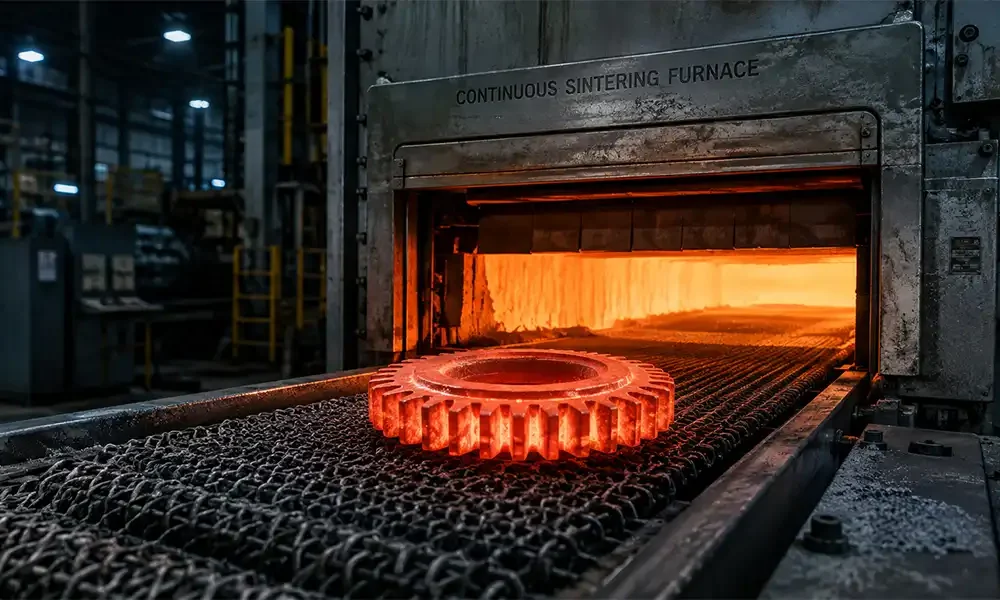

Powder metallurgy, which provides superior efficiency in industrial parts manufacturing, is based on the principle of shaping special alloyed metal powders in high-tonnage presses and sintering them at temperatures just below their melting point. This process creates high-level mechanical strength by ensuring that the materials bond together at the molecular level.
Our production line consists of four main stages: Homogeneous mixing of raw materials in project-specific ratios; shaping the parts into their initial form by pressing them into molds; heat treatment (sintering) performed in controlled-atmosphere furnaces; and finishing touches such as calibration, coating, or oil impregnation, depending on the intended end use.
Why Should the Sintering Method Be Chosen?
In traditional machining, a significant amount of scrap and waste is generated when machining solid metal blocks. In sintering technology, however, raw material loss is less than %5. In addition to being environmentally friendly, it offers the following unique advantages for production processes:
- One-Step Complex Production: Asymmetrical shapes, stepped structures, or blind holes that would otherwise require separate machining on CNC machines are produced from the die in a single press stroke using this technology, without the need for additional operations.
- Economical Mass Production: Especially in high-volume projects of 20,000 units or more, the investment in molds pays for itself quickly, radically reducing costs per part.
- Flawless Standardization: Thanks to advanced molding technology, there is no deviation in dimensions—even by a single millimeter—between the first product manufactured and the 100,000th product.
Industry Applications and Alloy Options
Powder metallurgy components are used with confidence in a variety of industries, including the automotive industry—the largest driving force in the global market—as well as home appliances, electric motors, the defense industry, and agricultural machinery.
Transmission components, hydraulic pump gears, shock absorber parts, and self-lubricating (maintenance-free) bronze bushings are among our most common solutions. Depending on the load your project will be subjected to and its operating environment, our engineers carefully select from various powder metallurgy alloys, such as iron, steel, bronze, or stainless steel.
Transition to Production and Engineering Solutions
The transition from machining to powder metallurgy is achieved not merely by copying existing technical drawings, but through design optimizations tailored to the nature of the process.
Our team of expert engineers will make your project production-ready by relaxing unnecessary tight tolerances on your part and revising details that complicate manufacturing, such as undercuts. We analyze the speed, load, and operating temperature your part will be subjected to in order to select the correct density class, and we ensure the success of your project through functional testing prior to mass production.